Automated enforcement won’t kill you but speed will.
Have you ever arrived late to a meeting, a birthday, or a movie knowing full well you were late? Did you slide casually into the back of a room or blend into a group, pretending you were there all along, desperately hoping no one noticed?
Even if no one sees you, most of us still feel that combined glimmer of guilt and sigh of relief when we get away with it. This is because we know we should have planned better, done better to be on time. We may even chastise ourselves and commit to leave earlier the next time.
Why speed?
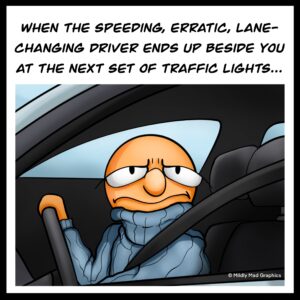
Speeding, and our reasons for doing it, aren’t really all that different. We committed to be some place, do something at a given time, but didn’t plan accordingly for whatever reason. Speeding is the attempt to avoid consequences, real or perceived, hoping to still slide back to the designated speed limit, unnoticed, without getting caught, while breathing a sigh of relief.
Or it may be that speeding just feels fun in the moment or gives us a sense of control over that annoying driver on the road. People believe their driving skills will save them; that they are such good drivers they won’t crash. They’ll tell you with pride…I’ve never been in one…the single word yet hanging quietly in the air.
Irrespective of the reason for speeding, there is still the sense of relief as you ease back to the limit. You are thankful you weren’t detected as you flew around that corner, past that school at lunchtime, or through that intersection, on a yellow no less. You weren’t stopped; weren’t caught. You believe you got away with it.
But did you?
If you have to wonder, the answer is no.
Every other driver, cyclist, rider, pedestrian and general bystander on the road did, in fact, see you.
They noticed because you put their lives, their loved ones, and their community at risk. They are unwilling witnesses to your dangerous behavior.
Balancing the scales of justice
So why do ardent critics of automated speed enforcement believe cameras are unfair, or worse, illegitimate? Why do they believe speeding tickets are valid only if a police officer actually observes a driver speeding in person?
 Let’s consider this belief system for a moment. Our criminal justice system is based on rules of evidence to protect against wrongful convictions and the imposition of unwarranted sanctions. Innocence is presumed. Moreover, the benefit of the doubt is always in favor of the accused. Evidence must be substantiated and carefully scrutinized. Everything has to add up.
Now let’s imagine for a moment that a different law of the land exists, where offenders can’t be prosecuted if a designated authority like a police officer didn’t actually catch you red-handed. The observations by bystanders or victims, pictures of the crime, evidence of injuries or damage caused are all irrelevant. Sanctions simply cannot be imposed. There is no proof.
In other words, there are no crimes unless a police officer catches you in the act. No thefts, no assaults, no murders. And no tickets from automated speed enforcement cameras.
Sounds ridiculous, right? Just imagine if digital evidence was thrown out the window altogether, because it wasn’t considered valid, or enough. No pictures of the crime or crime scene, no crash analysis or reconstruction showing speed was a factor, no expert witnesses backed up by science and data. Officers simply wouldn’t be able to lay charges if they didn’t observe the crime first-hand.
Can we really ignore evidence in the digital age
 But today, digital evidence is commonplace and even ingrained in our society. At the most basic level, let’s consider the dreaded late fees. We’ve all paid at some point for missed bill or credit card payments, for not paying taxes by the deadline, even for not returning a library book (you remember libraries right; the internet in paper form).
No one saw you be late. But there is digital evidence in the form of a timestamp that you were late. Have you ever argued with a service or account representative about the validity of a late fee?
Spoiler alert…it doesn’t matter if no one literally saw you submit your payment late. Rules are rules.
Then there is late homework, assignments slid into a pile on the teacher’s desk when no one is looking. Marks are (or at least for us Gen-Xers they were) routinely deducted. And believe me when I say parents were not coming down to back up our excuses or argue our case for us. All we got was I hope you learned your lesson, followed by a Don’t let it happen again…from our parents.
If our point is still not yet clear, We’ll spell it out. Society has long-since evolved past the belief that the only tangible evidence a crime has occurred comes from first-hand, credible eye-witness testimony.
We haven’t relied on such nonsense since the Salem Witch Trials.
Automated speed enforcement IS effective
So, why the strong opposition to automated speed enforcement? There is clear and convincing evidence it works. In fact, it’s existed for decades.
 A summary of the evidence on automated speed enforcement (ASE) (Lyon et al., 2024) showed ASE programs decrease crashes from approximately 9% to 18% for all crash types and up to 51% for injury crashes. This report also showed communities with ASE programs had high levels of support. For example, the City of Ottawa surveyed residents and determined the level of support for ASE was high and varied by location type, including:
- Near schools: 87%
- Near playgrounds: 85%
- Near hospitals: 77%
- Near parks: 76%
- Near seniors’ residences: 76%
- On any road where there is speeding: 65%
Among those who reported receiving a ticket (14% of respondents), 79% said it modified their behavior, including 65% who said they reduced speed in most driving situations.
Evidence of deaths on our roads is equally compelling. Speeding remains a priority road safety issue in the U.S. The National Highway Traffic Safety Administration reported that in 2022, there were 12,151 people killed in speeding-related crashes or 29% of all traffic fatalities as well as an estimated 300,595 injuries (NCSA, 2024).
More concerning, an average of 18% of U.S. drivers from 2019-2022admitted to speeding through a traffic light, 16% reported speeding well over the speed limit, and 66% believed excessive speed is serious problem in a survey of U.S. drivers in 2022 conducted by the Traffic Injury Research Foundation (TIRF). In addition, a similar survey of Canadian drivers by TIRF revealed 91% of drivers reported at least occasionally seeing other drivers speeding, 13% reported having a near-crash experience due to speeding in the previous 3 months, and 2% reported having a speeding-related crash in the previous 3 months.
The real question we all need to consider as part of the automated speed enforcement debate, and every time we get behind the wheel, is simple: What kind of world do you and your children want to live in?
Living in a safe world is worth the cost of automated enforcement
 Do you want to get home safely and see your family and community get home safely? Or do you want to roll the dice?
Remember that twinge of guilt; that sigh of relief when you avoid getting caught? You feel it because you know it’s wrong, it’s dangerous, and there are laws against speeding for a reason. Speeding is akin to Russian Roulette. Ultimately, people are guaranteed to be hurt; we just don’t know when it will happen, or to whom. Someone somewhere pays the price for speeding and if it’s not happened to you or someone you know, don’t forget the word …yet biding its time, echoing in the silence.
Supporting automated speed enforcement reflects a willingness to trade that momentary thrill of getting away with it to achieve a better, safer world. Does it mean we are more likely to be caught? Yes. But more importantly, it means we are less likely to do it in the first place.
#MySafeRoadHome blog co-authors: Robyn Robertson, TIRF President & CEO and Craig Lyon, Director, Road Safety Engineering, work collaboratively as co-authors. Robyn is the author of TIRF’s knowledge translation model, is well-versed in implementation strategies and operational practices across several sectors. Craig is a senior research scientist with a background in transportation engineering focusing on road safety. Craig’s research interests are in the application of statistical analysis methods to understand the effects of the roadway, drivers and administrative policies on road safety.
Source document:
National Center for Statistics and Analysis. (2024, July). Speeding: 2022 data (Traffic Safety Facts. Report No. DOT HS 813 582). National Highway Traffic Safety Administration
Traffic Injury Research Foundation, Lyon, C., Delavary, M., Cicchino, J., Hu, W., & Wolfe, D. (2024). Examining automated speed enforcement programs in Canada. Traffic Injury Research Foundation. https://tirf.ca/download/automated-speed-enforcement-canada/